Launch offer — valid today only

📄 Digital book in PDF · read it on your phone or print it

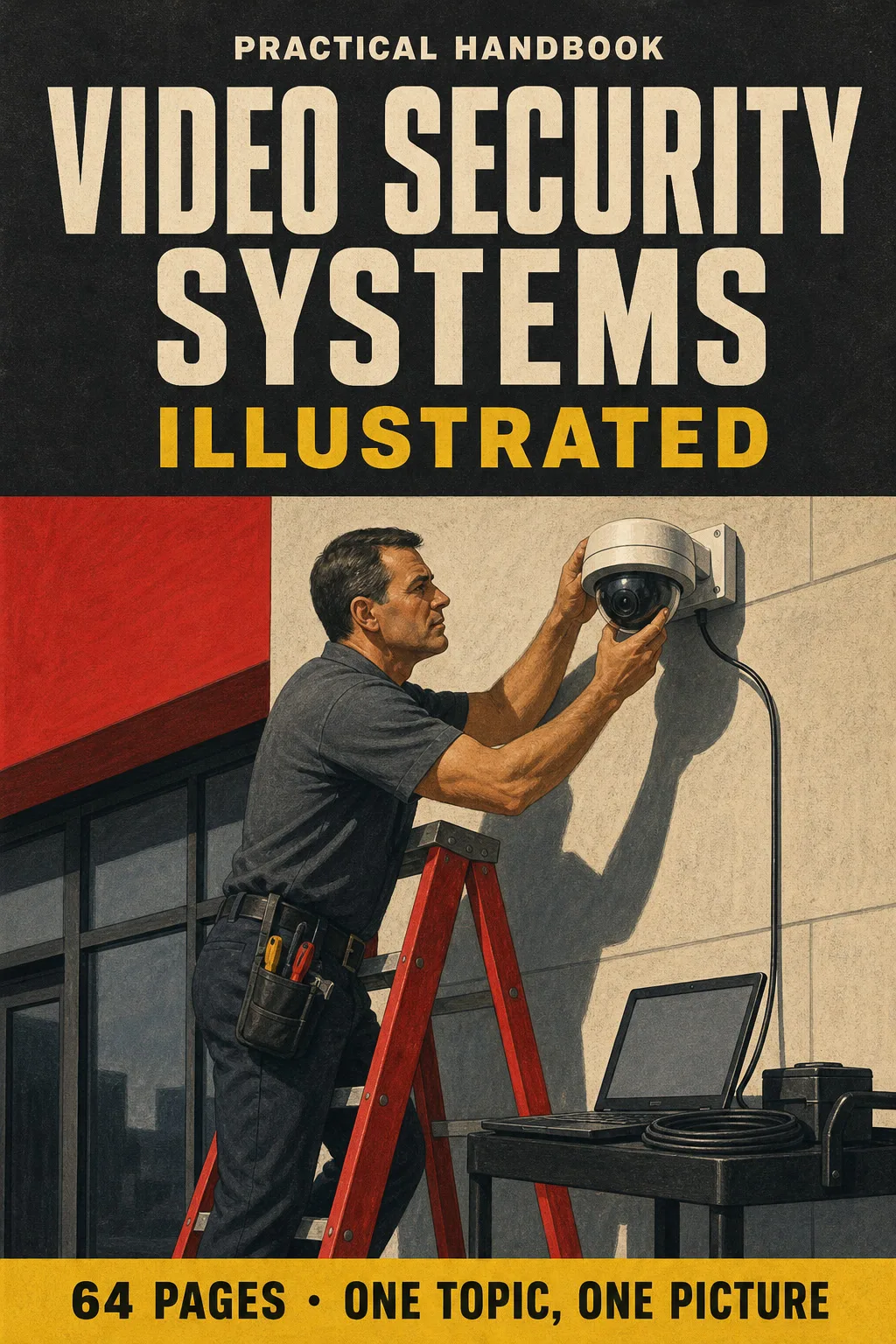
Video Security Systems, Illustrated: Lens, PPF, PoE, and Storage Math, Step by Step One Topic on Every Page

Lenses, pixels per foot, DORI levels, PoE budgets, VLANs, bandwidth, storage, cabling and commissioning. Every topic gets its own page: the drawing first, then what you need to remember. 64 illustrated pages.

GET THE 64 ILLUSTRATED PAGES

🔒 Secure checkout · PDF by email · 30-day guarantee

Every topic, its own pageEach calculation drawn, with the explanation right beside it
64 illustrated pages64 illustrated pages in 8 parts, from the video chain to commissioning
Up-to-date sourcesNEC (NFPA 70), IEEE 802.3 PoE and IEC 62676-4
PDF by emailFormat

Look Inside the Book

Every page has one big drawing and a box with the numbers and steps you need to know:

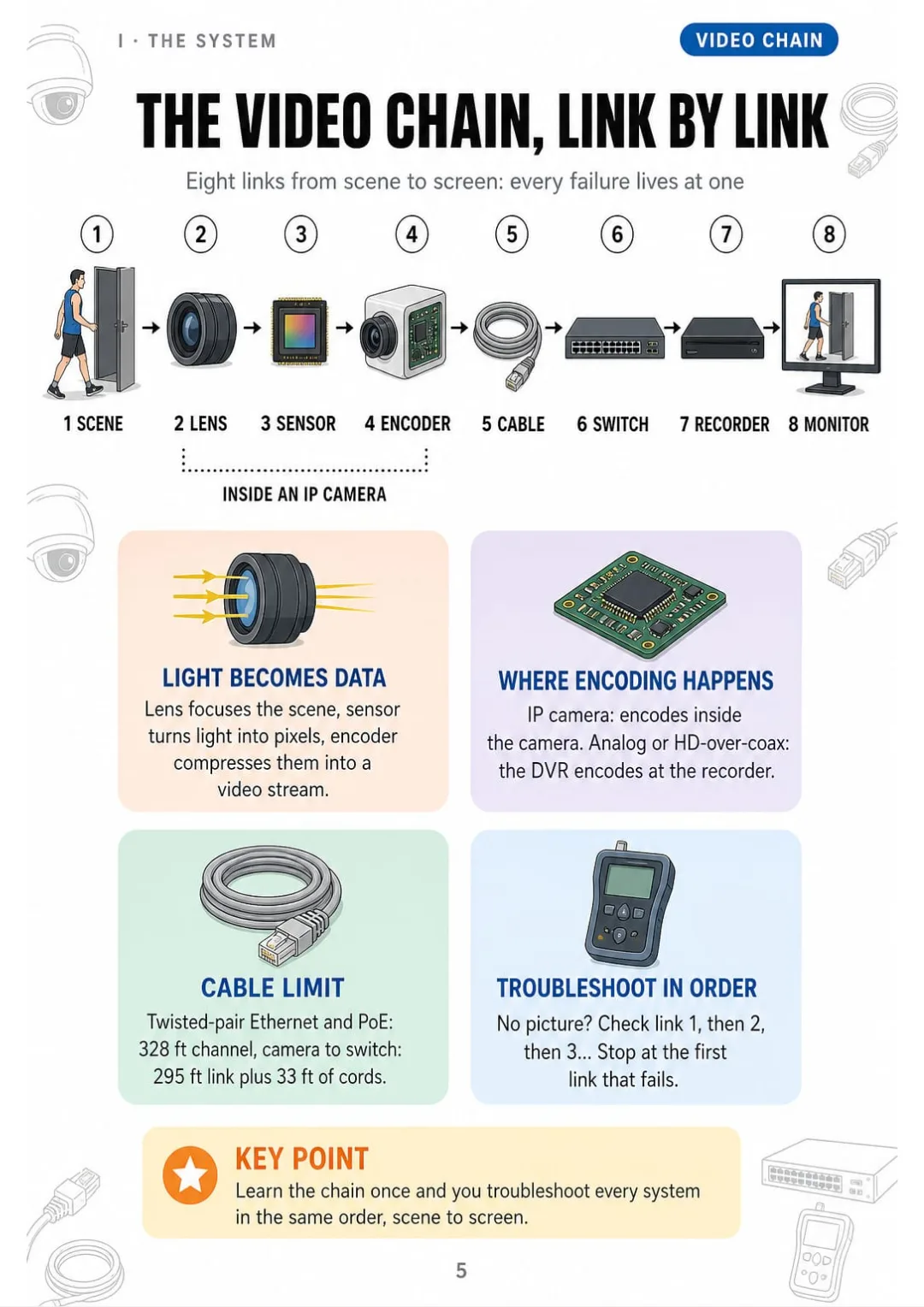
Scene → lens → sensor → encoder → cable → switch → recorder → monitor, drawn on one page.
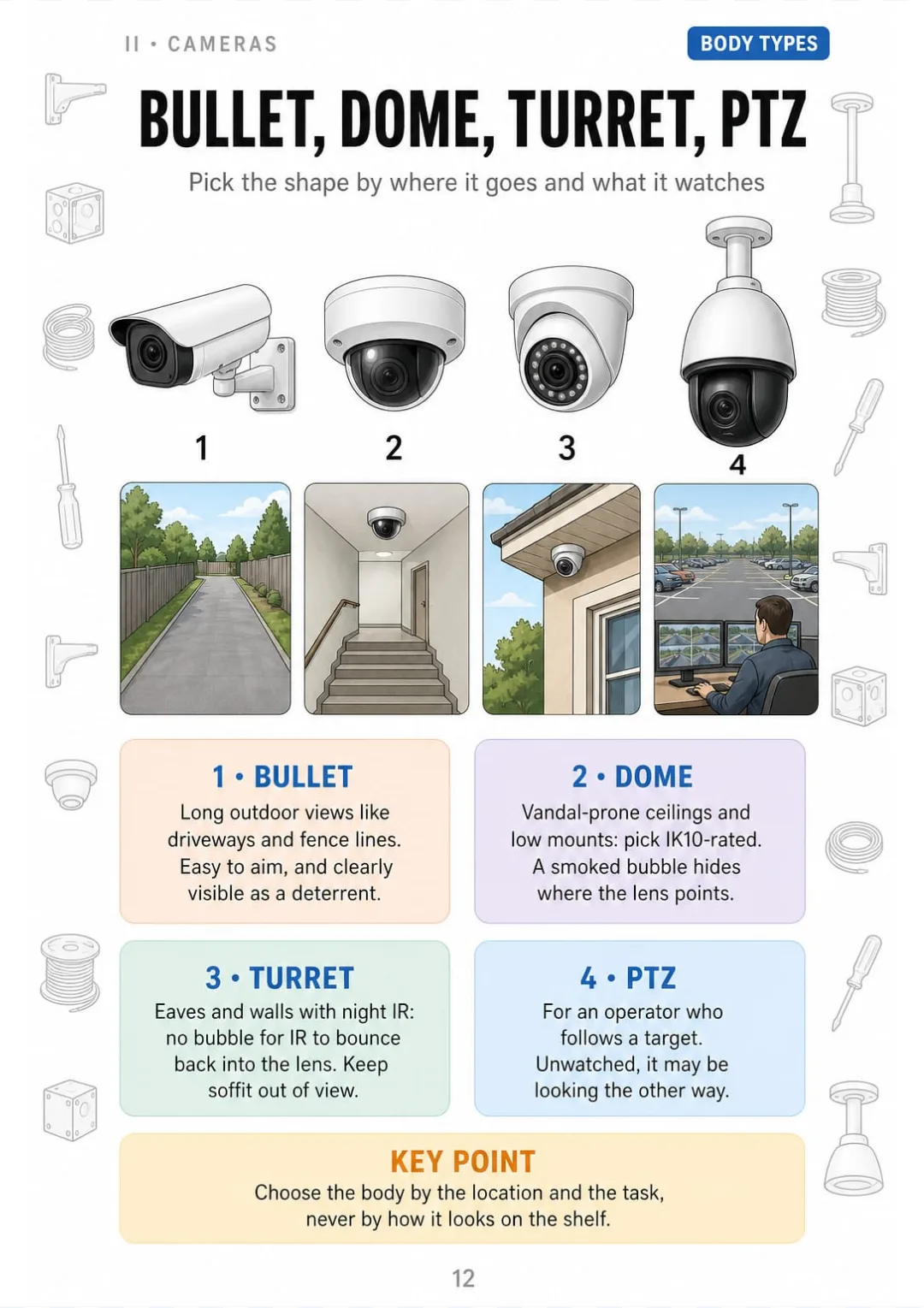
Bullet for long outdoor views, dome for vandal-prone ceilings, turret against IR bounce, PTZ for an operator.
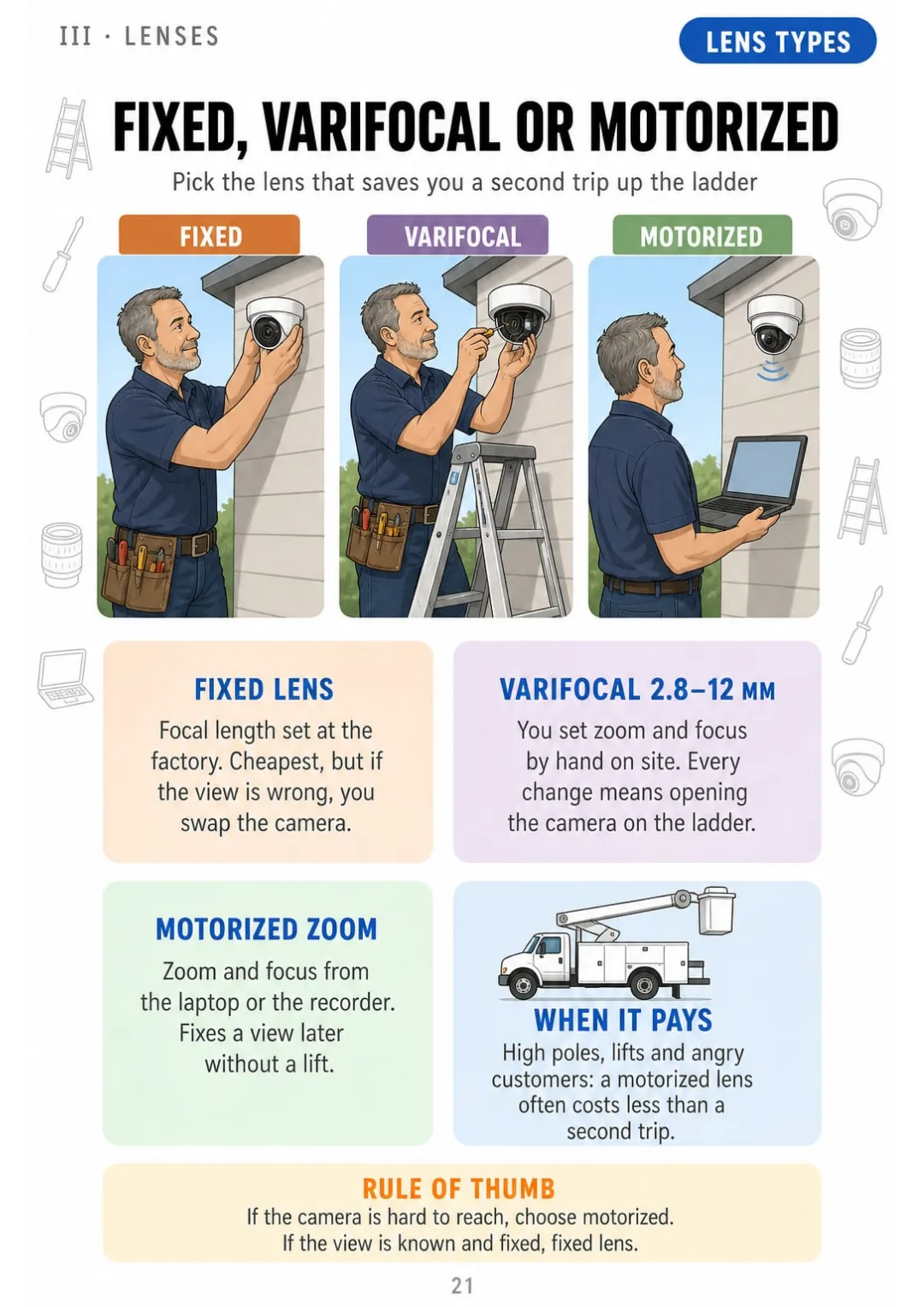
Fixed is set at the factory, varifocal by hand on site, motorized from the laptop.
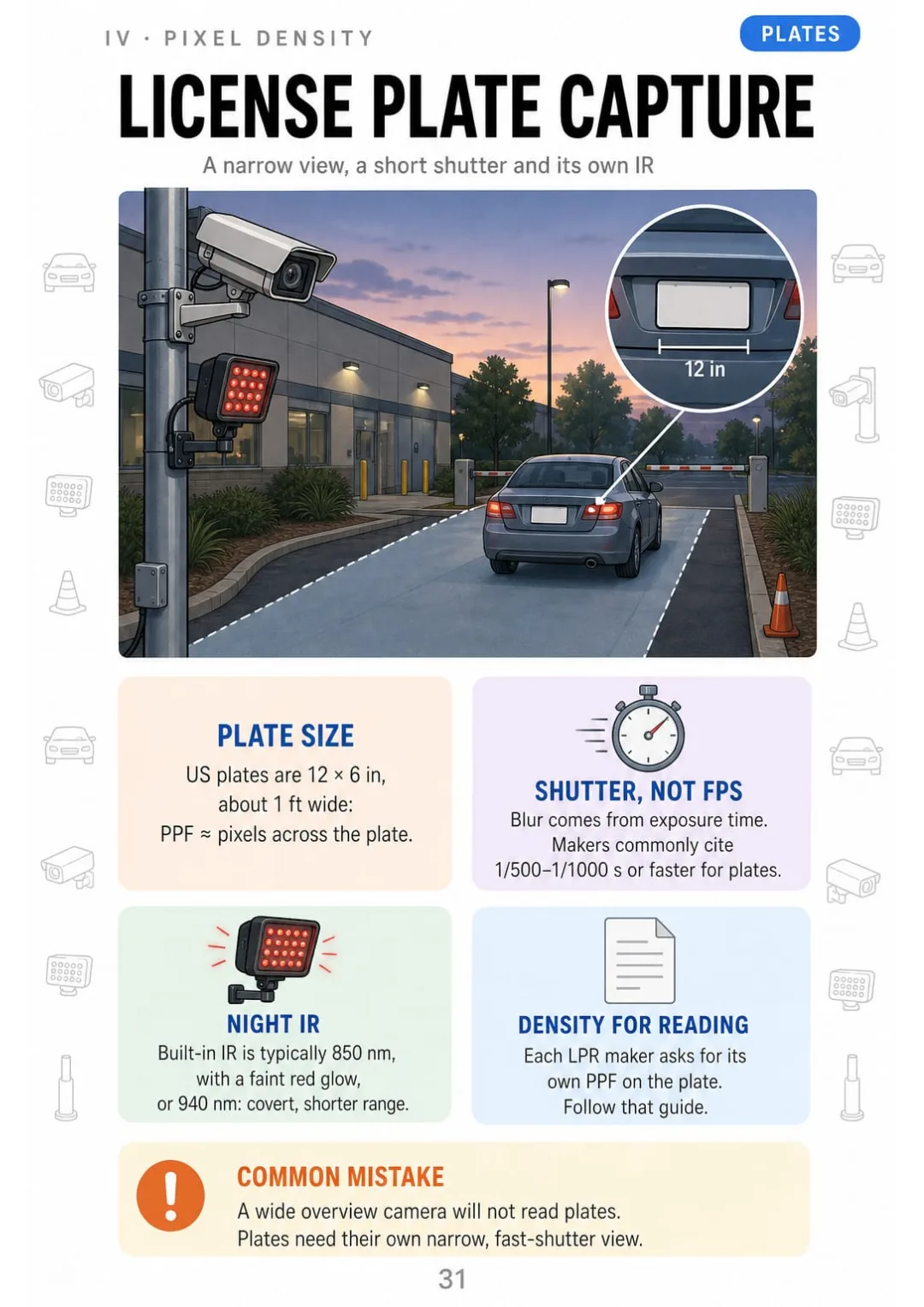
US plate = 12 in wide, so PPF ≈ pixels across the plate; shutter around 1/500–1/1000 s.
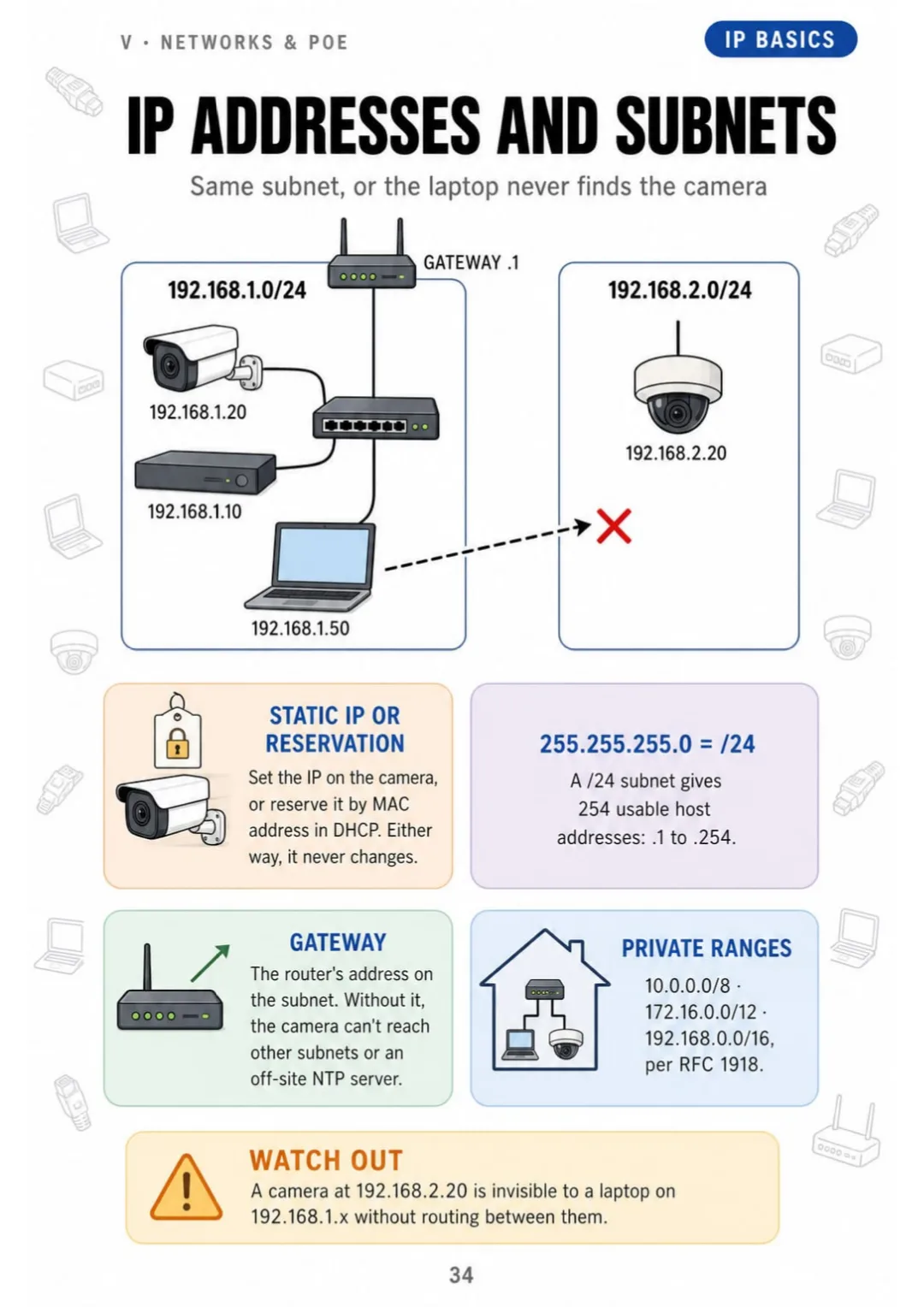
255.255.255.0 = /24 = 254 usable addresses, gateway included
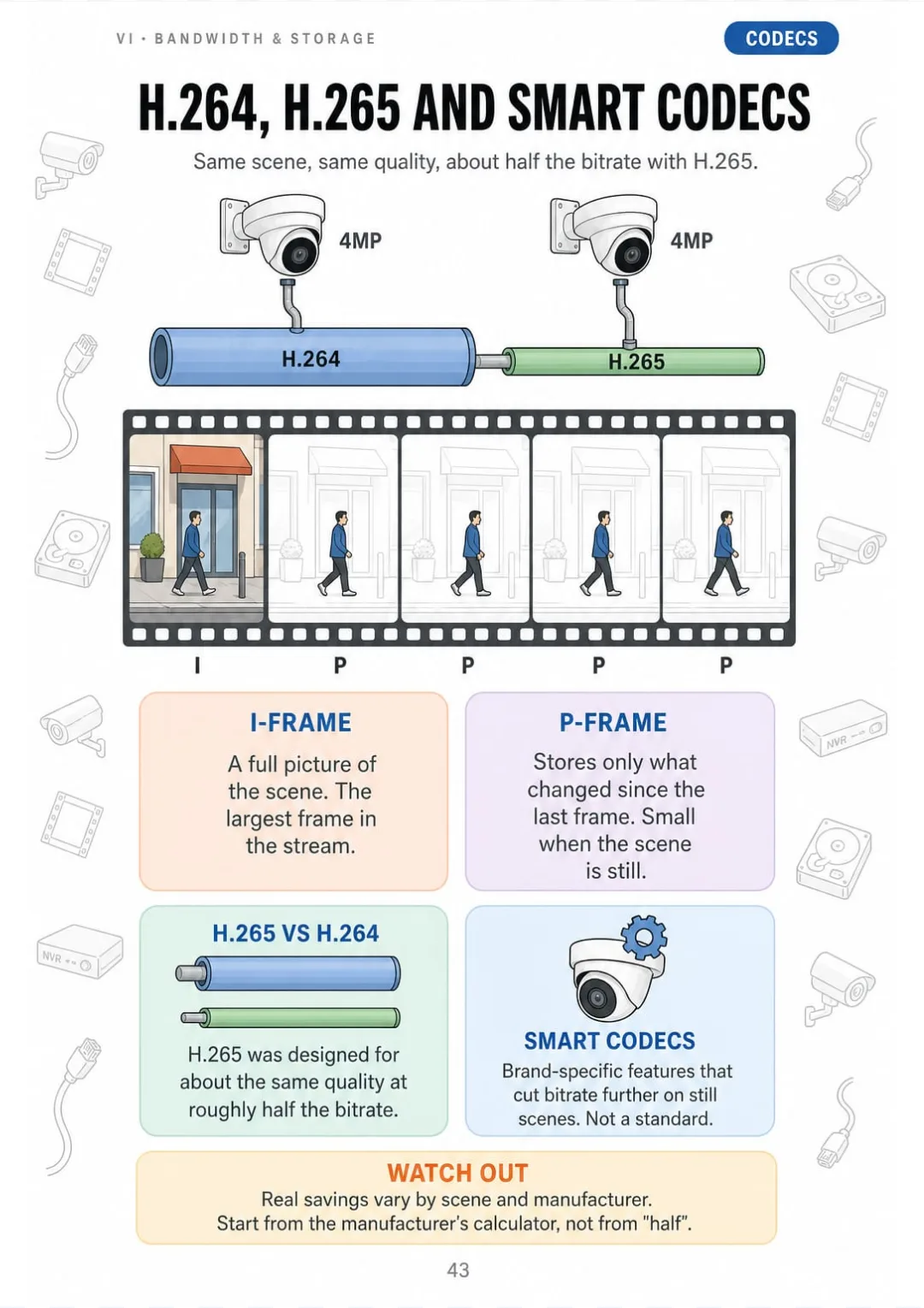
I-frames, P-frames and why H.265 targets about half the bitrate of H.264
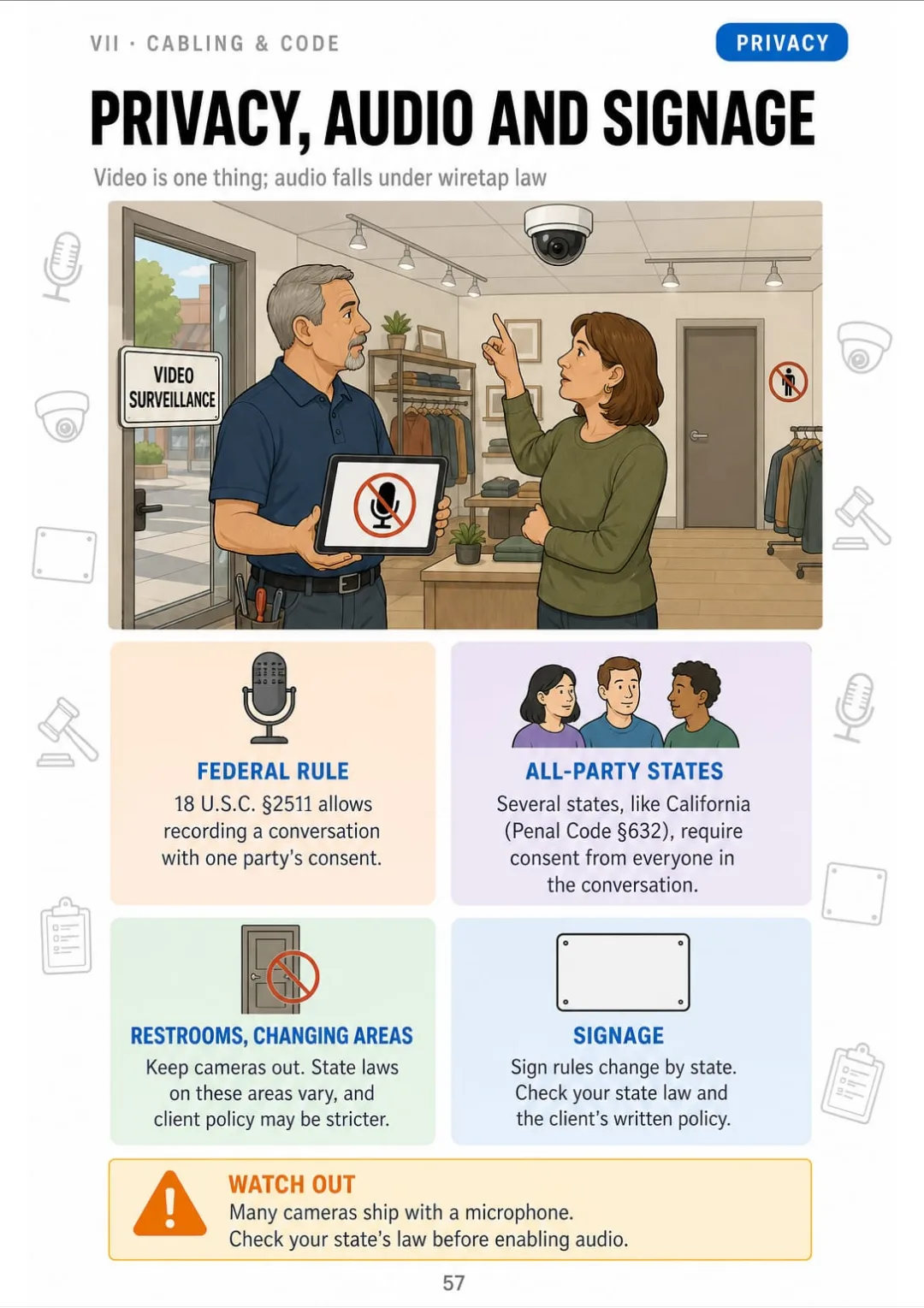
Audio: one-party consent federally, all-party in states like California
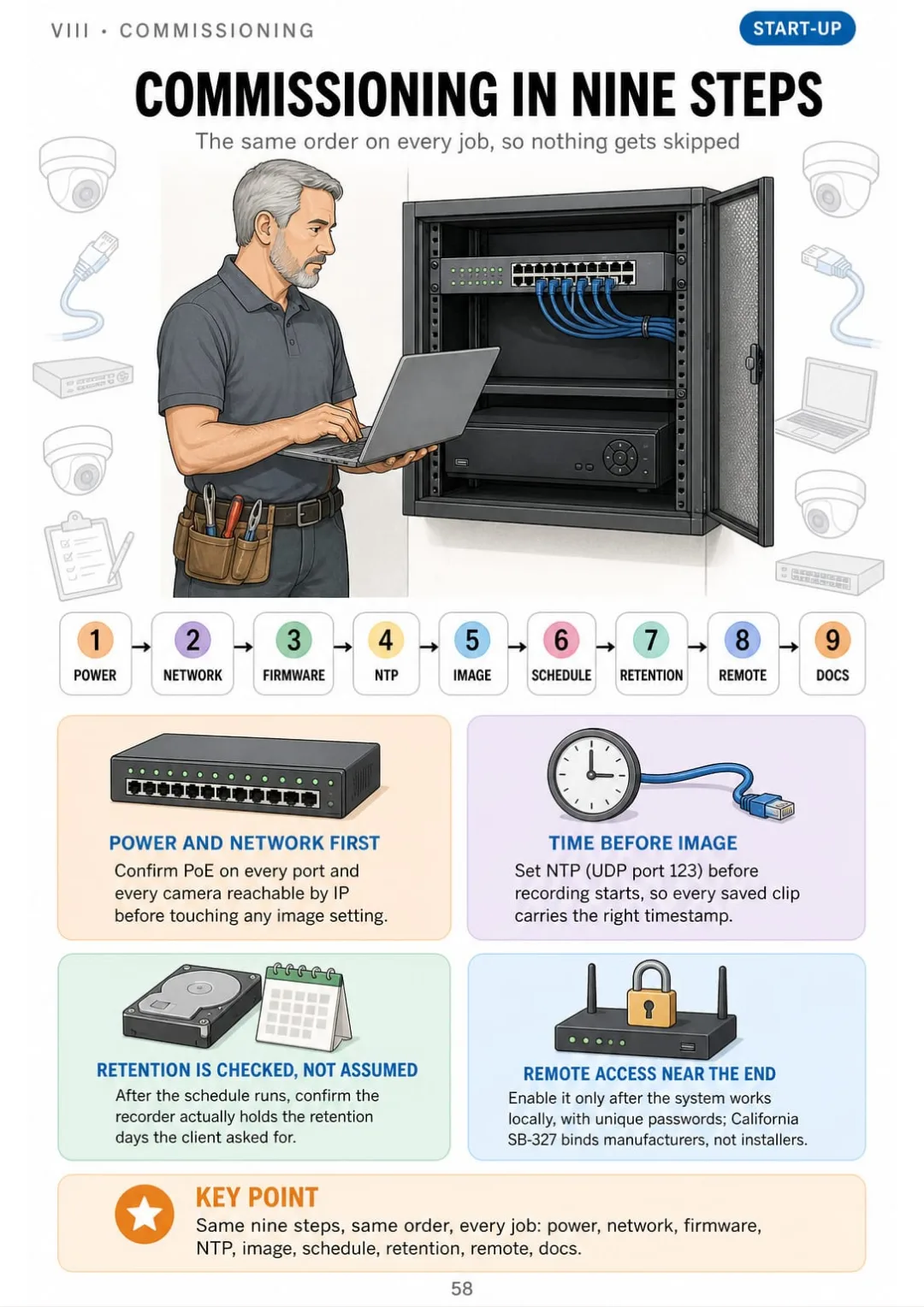
Power → network → firmware → NTP → image → schedule → retention → remote → docs.

Swipe to see more →

These are real pages from the book. The table of contents is the full one: 8 parts and 60 topics.

The Problem Isn't You. It's How It Was Explained to You.

You're standing under a pole with two lenses in your hand, and the customer asks why 6 mm and not 2.8. You know which one works. Explaining why is another story.

The manual covers focal length in three paragraphs of angles, sensor formats and formulas. Nothing on the page looks like what you see from the ladder.

Fixed is set at the factory, varifocal by hand on site, motorized from the laptop.

Here, focal length is one drawing: 2.8, 4, 6 and 12 mm, all from the same pole, each with its scene width marked. Double the mm, half the width.

Pixels per foot, the PoE budget, storage for 30 days, subnets and the commissioning order work the same way: each one has its own page.

You see it, you get it, and you do the math without going back to the manual.

COMPARE FOR YOURSELF

The Same Topic, Two Ways to Study It

THIS
  • The manual: line after line after line
  • Camera types explained only in words
  • You walk into the exam with doubts
Camera housings are commonly classified according to form factor. The bullet configuration, characterized by an elongated cylindrical enclosure, is generally deployed in exterior applications requiring extended viewing distances, whereas the dome configuration incorporates a transparent hemispherical cover which may afford increased resistance to impact and tampering. The turret configuration separates the lens assembly from the cover, thereby mitigating internal reflection of infrared illumination. Pan-tilt-zoom units provide operator-controlled repositioning and optical magnification, subject to the limitations of preset tours and mechanical wear.
FOR THIS
  • Each camera body in one drawing
  • Where each one goes, in a box
  • You see it and you get it
Bullet for long outdoor views, dome for vandal-prone ceilings, turret against IR bounce, PTZ for an operator.
CONTENTS

Take a Look at the 8 Parts and 60 Topics

How the system fits together, cameras, lenses, pixel density, networks and PoE, bandwidth and storage, cabling and code, and commissioning: 64 pages, all illustrated.

IHow a Video System Fits Together · pp. 5-11
  1. The Video Chain, From Lens to Screen
  2. Analog, HD-over-Coax and IP Side by Side
  3. DVR, NVR and VMS: Who Does What
  4. Edge, On-Prem and Cloud Recording
  5. The Site Survey Before Anything Else
  6. Operational Requirement: Why This Camera Here
  7. Reading Security Drawings and Symbols
IICameras and the Image · pp. 12-19
  1. Camera Body Types: Bullet, Dome, Turret, PTZ
  2. Multisensor and Fisheye Cameras
  3. Sensor Size and What It Changes
  4. Resolution: Pixels Across the Image
  5. Lux and Low-Light Ratings
  6. WDR and the Backlit Door
  7. Day/Night: IR Cut Filter and IR Range
  8. Shutter Speed and Motion Blur
IIILenses and Field of View · pp. 20-26
  1. Focal Length in One Drawing
  2. Fixed, Varifocal and Motorized Zoom
  3. Angle of View Versus Field of View
  4. The Lens Formula in Four Steps
  5. Scene Width From a Known Lens
  6. Iris, F-Stop and Depth of Field
  7. Focusing and IR Shift
IVPixel Density: Detect, Observe, Recognize, Identify · pp. 27-33
  1. Pixels per Foot: The One Number That Decides
  2. The Four DORI Levels Drawn
  3. From PPF Back to Scene Width
  4. The Full Camera Pick in Five Steps
  5. License Plate Capture
  6. Mounting Height and Angle Cost Pixels
  7. Worked Examples: Gate, Parking Lot, Register
VNetworks and PoE · pp. 34-42
  1. IP Addresses and Subnets for Cameras
  2. Switch Ports and Uplinks
  3. VLANs: Keeping Cameras Off the Office Network
  4. PoE Standards and Their Watts
  5. The PoE Budget in Four Steps
  6. Classes, Heaters and the Winter Reboot
  7. 328 Feet and How to Go Beyond
  8. Injectors, Midspans and Non-PoE Switches
  9. Remote Access Done Safely
VIBandwidth and Storage · pp. 43-49
  1. Codecs: H.264, H.265 and Smart Codecs
  2. CBR Versus VBR
  3. Frame Rate: How Many You Really Need
  4. Bandwidth Math in Three Steps
  5. Storage Math in Five Steps
  6. Motion Recording and Retention Days
  7. RAID and Drive Choice
VIICabling, Mounting and Code · pp. 50-57
  1. Cat5e, Cat6, Cat6A and Coax
  2. Terminating to T568A and T568B
  3. Testing: Wiremap, Length and Certification
  4. Class 2 Circuits and the NEC
  5. PoE Cable Bundles and Heat
  6. Grounding, Bonding and Surge Protection
  7. Mounting: Walls, Poles, Corners and Ceilings
  8. Privacy, Audio and Signage
VIIICommissioning, Handover and Review · pp. 58-64
  1. Commissioning in the Same Order Every Time
  2. Time Sync and Why Evidence Depends on It
  3. Day and Night Image Check
  4. As-Builts and Handover Documents
  5. Troubleshooting by the Chain
  6. The Four Calculations on One Page
  7. Most Frequent Mistakes on the Exam and the Job

One Page, One Topic, All Clear

Think of it this way:

The customer wants to identify faces across a 20-foot-wide front entrance. Your supervisor asks which camera, and the exam can ask the same thing with different numbers.

You open the pixels-per-foot page and it's drawn: 1920 pixels across 20 feet of scene, 96 PPF, with the four DORI levels marked right next to it.

255.255.255.0 = /24 = 254 usable addresses, gateway included

Same with the lens formula, the PoE budget, storage math, VLANs and commissioning: each one on its own page.

Video Security Systems Illustrated is 8 parts and 60 topics, all drawn, and it closes with the four calculations on one page and the most frequent mistakes on the exam and the job.

What you see drawn, you don't have to memorize.

What's Inside Video Security Systems Illustrated:

Ipp. 5-11

How a Video System Fits Together

The video chain from lens to screen, analog vs. HD-over-coax vs. IP, DVR, NVR and VMS, recording options, the site survey, operational requirements and security drawing symbols.

IIpp. 12-19

Cameras and the Image

Bullet, dome, turret and PTZ, multisensor and fisheye, sensor size, resolution, lux ratings, WDR at the backlit door, IR cut filter and IR range, shutter speed.

IIIpp. 20-26

Lenses and Field of View

Focal length in one drawing, fixed vs. varifocal vs. motorized, angle vs. field of view, the lens formula in four steps, scene width, iris and depth of field, IR shift.

IVpp. 27-33

Pixel Density: Detect, Observe, Recognize, Identify

Pixels per foot, the four DORI levels drawn, from PPF back to scene width, the camera pick in five steps, license plates, mounting height and worked examples.

Vpp. 34-42

Networks and PoE

IP addresses and subnets, switch ports and uplinks, VLANs, PoE standards and watts, the PoE budget in four steps, heaters, 328 feet and beyond, injectors and safe remote access.

VIpp. 43-49

Bandwidth and Storage

H.264, H.265 and smart codecs, CBR vs. VBR, frame rate, bandwidth math in three steps, storage math in five steps, motion recording, retention days and RAID.

VIIpp. 50-57

Cabling, Mounting and Code

Cat5e, Cat6, Cat6A and coax, T568A and T568B, testing, Class 2 circuits and the NEC, PoE bundles and heat, grounding and surge, mounting, privacy and signage.

VIIIpp. 58-64

Commissioning, Handover and Review

Commissioning in the same order, time sync, day and night checks, as-builts and handover, troubleshooting by the chain, the four calculations on one page and the most frequent mistakes.

At the end of the book: The four calculations on one page and a review of the most frequent mistakes on the exam and the job.
Plus: 2 Free Books

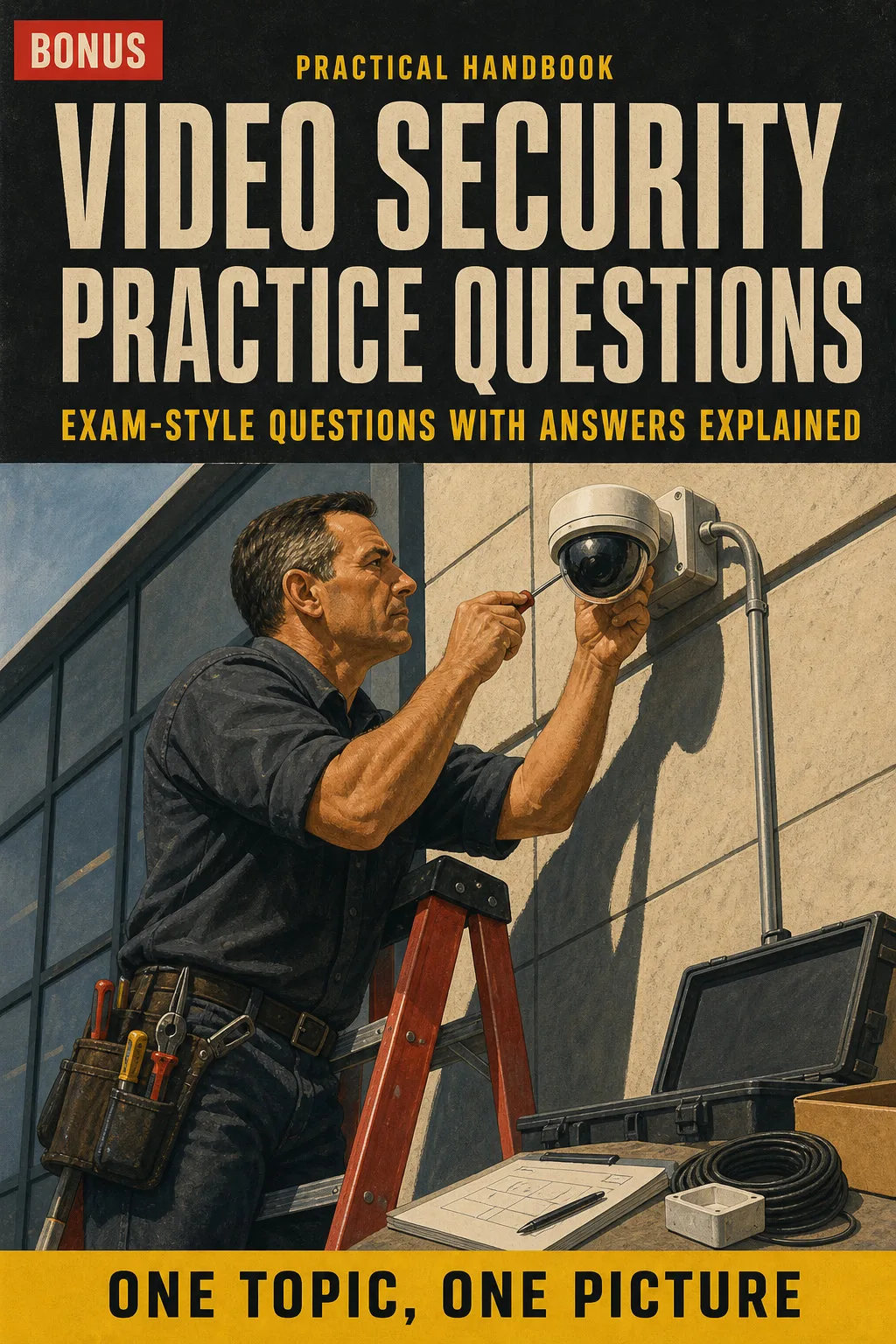
Video Security Practice Questions: Exam-Style Questions with Answers Explained

BONUS 1: «Video Security Practice Questions: Exam-Style Questions with Answers Explained»

Value on its own: US$ 17.90

Practice the way the exam asks: lens, pixel-density, PoE and storage questions, each with the answer worked out step by step so you can see where you went wrong.

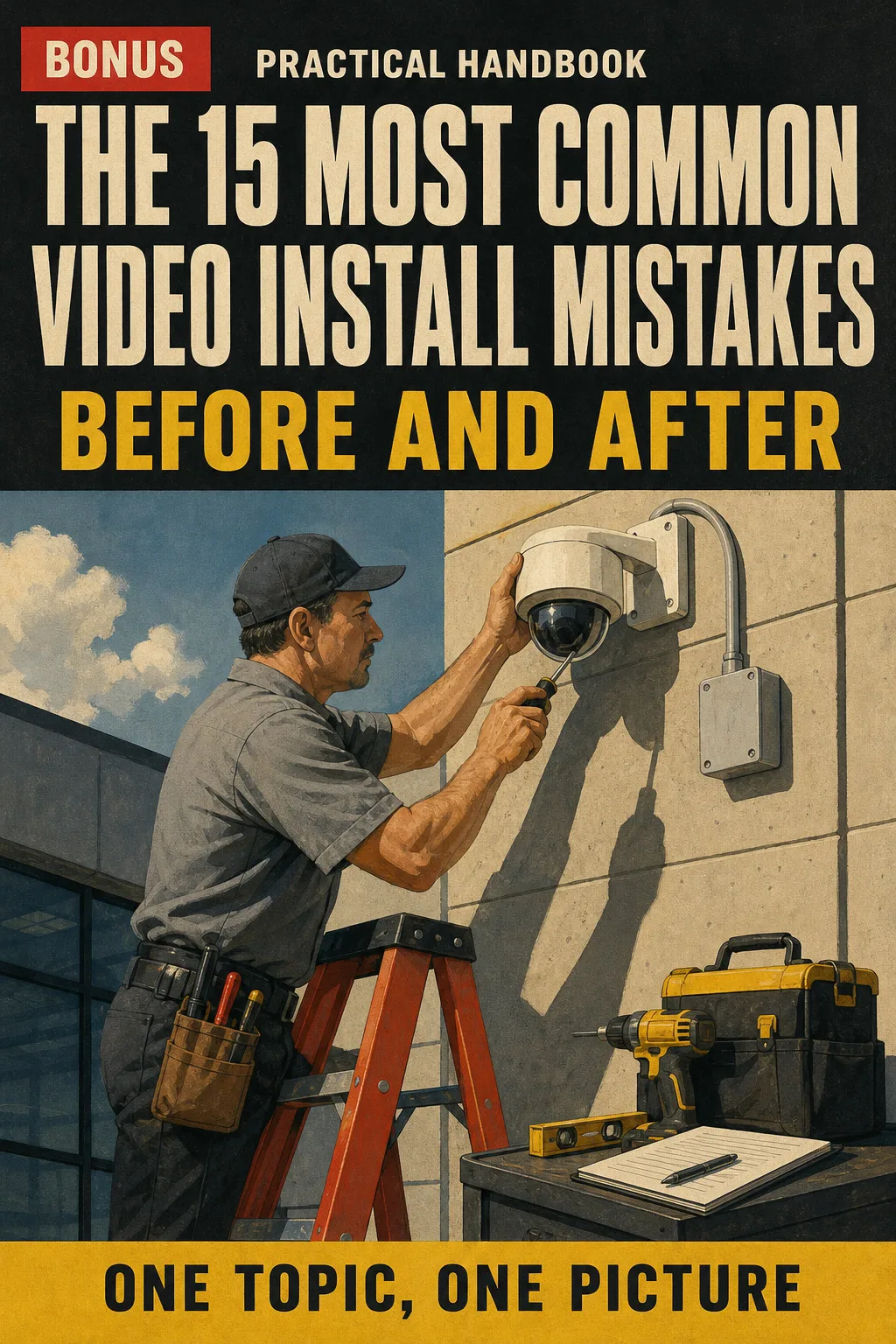
The 15 Most Common Video Install Mistakes: Before and After

BONUS 2: «The 15 Most Common Video Install Mistakes: Before and After»

Value on its own: US$ 14.90

Each common mistake drawn twice, wrong and right (backlit cameras, blown PoE budgets, washed-out IR, leaky mounts), so you can catch it on paper before it costs you a callback.

Video Security Systems Illustrated with 2 Free Books

  • Video Security Systems Illustrated: 64 illustrated pagesUS$ 63
  • BONUS 1: Video Security Practice Questions: Exam-Style Questions with Answers ExplainedUS$ 17.90
  • BONUS 2: The 15 Most Common Video Install Mistakes: Before and AfterUS$ 14.90
  • High-resolution PDF to printIncluded
Total value US$ 95.80
YOUR PRICE:
US$ 27
You save US$ 68.80
YES, I WANT VIDEO SECURITY SYSTEMS ILLUSTRATED FOR US$ 27

📄 This is a digital PDF book sent to your email: nothing is printed or shipped.

Secure purchaseEncrypted payment30-day guarantee

PDF by email: We email you Video Security Systems Illustrated as a PDF, together with the two free books. It's a single payment: no installments, no extra charges.

Who This Book Is For

You're studying for Level I

You're studying for Level I

Every topic on its own page, drawn the way you see it on the job, so the theory finally lines up with what you already do.

Your exam date is set

Your exam date is set

The four calculations (lens, pixel density, PoE, storage) always in the same steps, with worked examples and practice questions to check yourself.

You already install cameras

You already install cameras

A printable reference for the truck, so you can show the customer or your supervisor why you picked that camera and that lens.

Everything You Get Today

US$ 95.80US$ 27
YES, I WANT VIDEO SECURITY SYSTEMS ILLUSTRATED FOR US$ 27

📄 This is a digital PDF book sent to your email: nothing is printed or shipped.

30DAYS
GUARANTEE

30-Day Guarantee

Try Video Security Systems Illustrated for 30 days, bonus books included.

We refund everything if the file won't open, if the book isn't what you see here, if you were charged twice or if the email doesn't arrive. Just email us.

You pay once. No subscriptions.

Frequently Asked Questions

Is it for me if I've installed cameras for years and haven't taken an exam in a long time?

Yes. It doesn't teach you to hang a camera: it puts the theory you already apply by eye in order, with the math in steps, the way the exam asks for it.

Where does the content come from?

From the NEC (NFPA 70), IEEE 802.3af/at/bt for PoE, ANSI/TIA-568.2-E and TIA-607 for cabling and bonding, and IEC 62676-4 for DORI levels. Code numbers are marked so you can check them against the edition your AHJ has adopted.

Is it official material?

No. It's independent study material for technicians preparing for video security certification in the US, such as NICET Video Security Systems Levels I and II. Check the topics against the current content outline from your certifying body. It doesn't issue a certificate or count as training hours, and it's not affiliated with or endorsed by NICET or any certifying body.

Does it replace a course or training?

No. It's a study and review aid. It doesn't replace formal training, manufacturer instructions or supervised field experience.

Are the practice questions the ones on the exam?

No. They're written for this book, in the style of exam questions, with each answer worked out step by step. They are not official exam questions.

When and how does it arrive?

As a PDF by email, at the address you enter at checkout. The 2 bonus books also come as PDFs by email.

Do I have to pay every month?

No. It's a one-time payment.

Can I have it on paper?

Yes. The PDF is made to print, so you can keep the pages you use most in a binder in the truck.

How does the refund work?

You have 30 days. We refund everything if the file won't open, if the book isn't what you see on this page, if you were charged twice or if the email doesn't arrive: just email us.

Before You Close This Page

No more rereading with nothing sticking.

Pixels per foot: you see it drawn and that's it.

You walk into the exam knowing where everything is.

Drawings make studying faster.

The book is right below.

One-time payment: US$ 27 · Guarantee: 30 days · PDF by email

YES, I WANT VIDEO SECURITY SYSTEMS ILLUSTRATED FOR US$ 27

📄 This is a digital PDF book sent to your email: nothing is printed or shipped.